While preparing your whey protein shake you might have noticed that when you shake hard or blend your protein, it creates some foam/froth on the top.
Do you need to be worried about it? The answer is no.
No, because foaming is a functional quality of proteins and a good quality, high purity protein does create foam.
Many people have this misconception that foaming is bad or whey protein shake should not create any foam. I don’t know where the idea came from but, it is incorrect.
There is no need to worry about foam on your whey protein, it does not mean your Whey protein is of poor quality or, it’s going to cause you any harm.
In this article, let’s talk about why proteins create foam, why it is a good sign, and what you can do to avoid foam if you don’t like it.
1.Why Whey proteins creates Foam?
Foaming is a functional quality of proteins, whether it’s in whey, egg, or milk. They all create foam when stirred, whisked, or shaken.
If you remember what happens when you whisk an egg, it creates foam. What happens when you shake milk, it creates foam.
You may have noticed when you had your cappuccino last time, what baristas do is, pass a lot of hot steam (air) through milk which creates that nice-looking froth to top off your cappuccino.
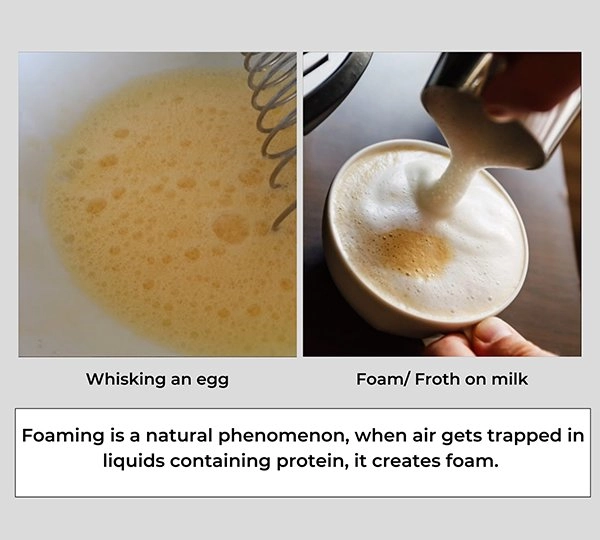
Foaming is a natural phenomenon, when air gets trapped in liquids containing protein, it creates foam.
There are a lot of studies about the foaming qualities of whey. Due to its foaming ability whey is used as a foaming and stabilizing agent in many bakery products to replace eggs.
Little chemistry lesson:
When you shake your whey, the shaking entraps air in protein molecules which creates foam on the surface. The reason for that is amino acids have two ends. One is hydrophilic and the other is hydrophobic. The hydrophilic (water-loving) ends orients themselves toward the water and the hydrophobic (water-hating) ends orient away from water.
The hydrophobic ends orient themselves towards air entrapping tiny air bubbles when shaken and create foam on the top of whey protein.
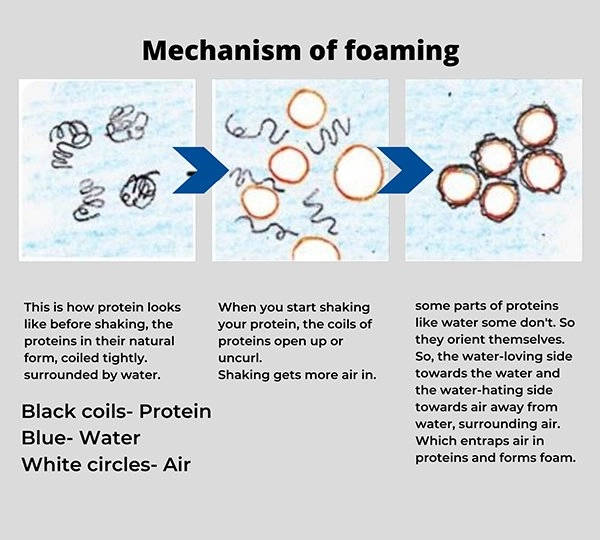
Foaming of whey protein is an important quality to consider because proteins only in un-denatured or undamaged form can create a stable foam.
2.Why foaming is a good sign
When proteins get damaged during their processing, the ends of amino acids also get damaged, which cannot entrap much air, thus making shakes without foam.
As you know, denatured or damaged proteins do not produce optimum results. The damaged ends of amino acids, hinder the ability of digestive enzymes to act on proteins (amino acids) decreasing their absorption and bioavailability.
So, if you have a lot of foam on your whey shake take it as a good sign.
We ran a little experiment to demonstrate, since visualization makes it easy to understand the concept. We took different proteins, added half a scoop of each to 100 mL of water and shook in a shaker for 30 seconds. Only at one instance we stirred instead of shaking to demonstrate the difference.
A.Quality
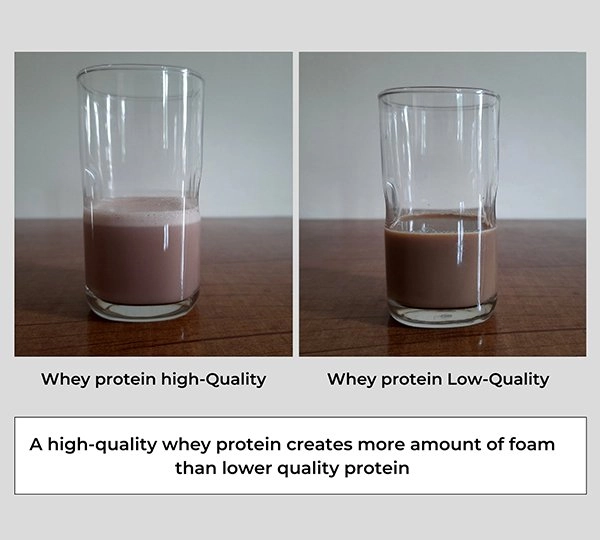
Proteins that are denatured or damaged and have lower quality and tend to make less or don’t make any foam at all. We call denatured or lower purity protein (not whey concentrate, but adulterated) a low-quality protein.
We took a known low-quality protein and shook it in a shaker for 30 seconds, then we took a high-quality protein and shook in the same way. The high-quality protein created more foam and the low-quality protein did not create any foam.
B.Purity
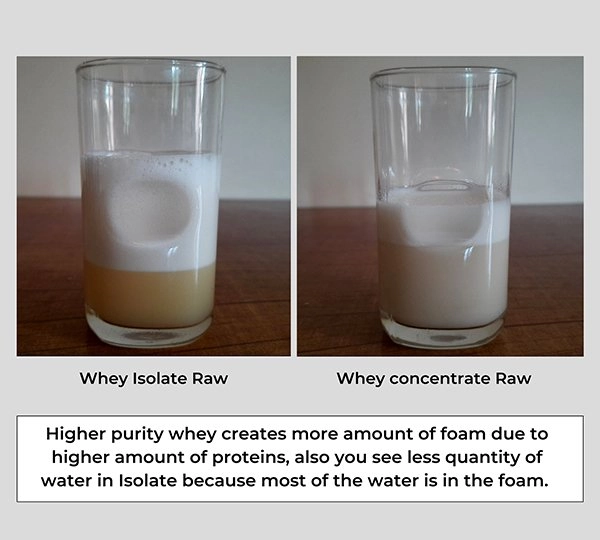
Proteins with higher purity tend to create more foam. You may have noticed that with whey concentrate and whey isolate. Whey Isolate creates more foam as compared to whey concentrate which has lower purity than Isolate
We took some raw whey isolate and raw whey concentrate to demonstrate this. We used raw material because addition of flavors decreases the amount of foam.
C.Amount of flavors
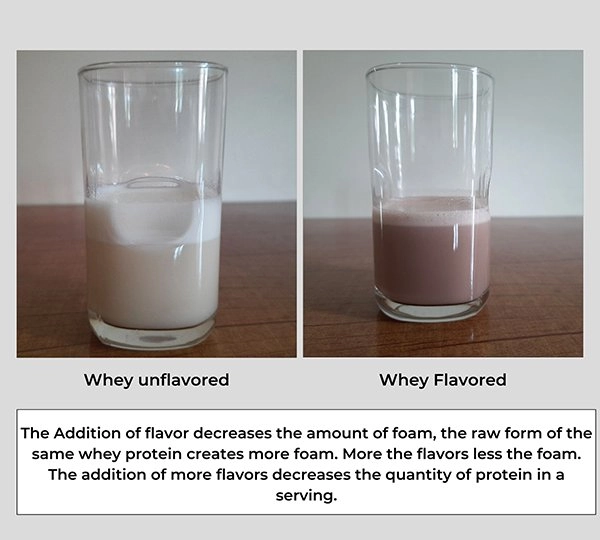
The addition of flavors affects foaming, the addition of more flavors decreases the amount of foam formed on the top. I won’t go into chemistry. But, if your whey protein has more flavors added to it, it will create less foam.
To demonstrate it we tried an unflavored and flavored version of the same protein. The unflavored version made a lot of foam upon shaking, while the flavored version created less foam. Both proteins were shaken for 30 seconds in a shaker.
Having too much flavor added to your shake is not a good thing, since addition of flavor reduces the quantity of protein per serving. The lower quantity of protein per serving is not a good value for your money.
3.How can you avoid foam?
If you don’t like foam on your whey shake then mix using a spoon or with a swirling motion. This will avoid much air getting trapped in the whey shake and give you a shake with less foam.
We tried this as well, we took two scoops of protein, mixed one of them by shaking in the shaker and the other with a spoon.
The one mixed with shake created foam and the other mixed with spoon did not create any foam because gentle stirring doesn’t allow much air to get entrapped.
1.Stir instead of shaking
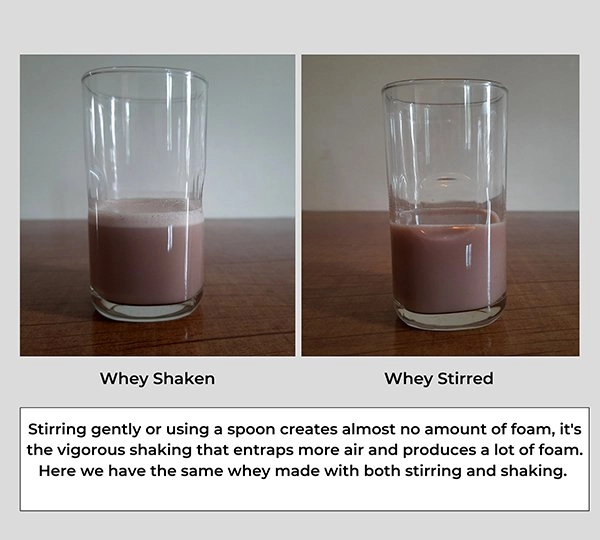
Meaning it is possible to avoid foaming by simply mixing it gently. The same whey protein can make a shake with or without foam depending on how you mix.
2.Allow to sit for a bit
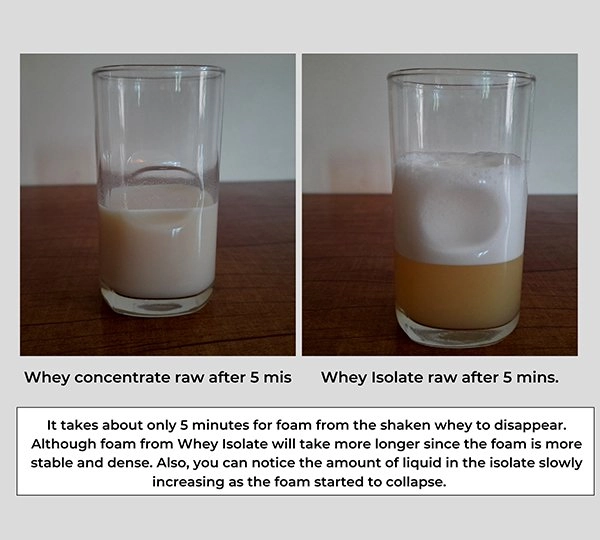
Or you can allow your whey shake to settle for some time and enjoy it when the foam is gone. It takes a small time for the foam to disappear. Foam from whey concentrate was gone quickly, while it took longer for whey isolate foam to disappear, because foam on the whey isolate was much dense and stable.
3.Shake gently
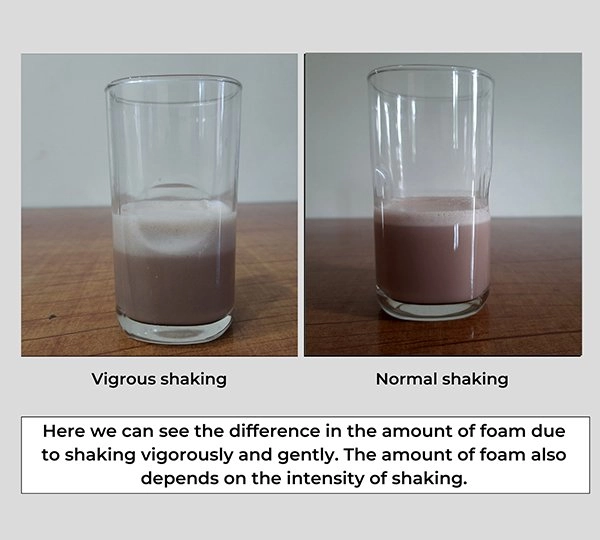
The amount of foam also depends on how vigorously you shake your shaker. More vigorous shaking entraps more air in the shake and creates more foam while gentle shaking can create less amount of foam.